
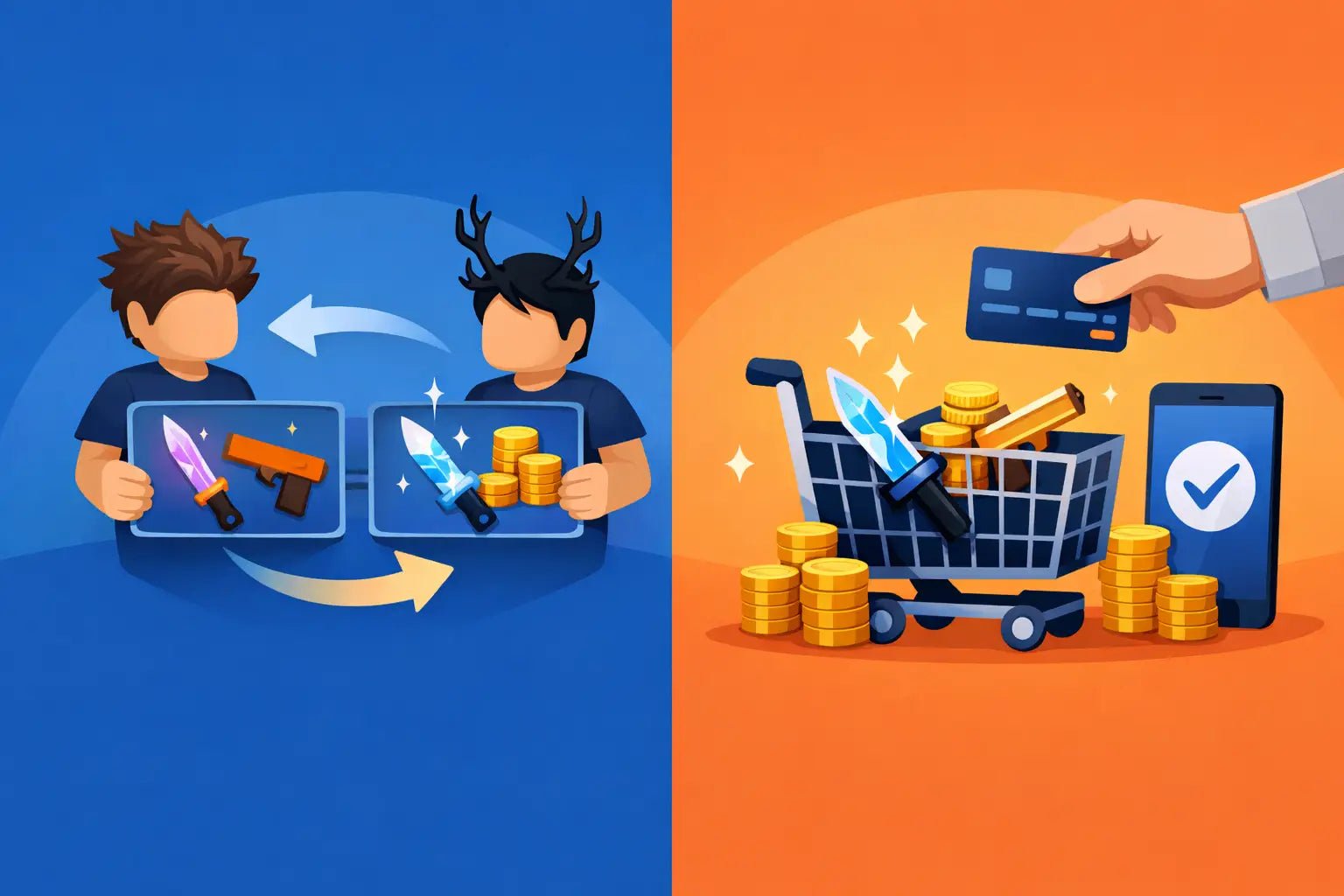
That big MM2 item you want can cost you more than Robux or cash - it can cost time, patience, and sometimes your whole mood for the day. When players compare mm2 trading versus direct purchase, they are usually trying to answer one real question: what gets me the item I want faster, safer, and with less hassle?
The answer is not always the same for every player. Some people love the chase, the negotiation, and the feeling of turning smaller items into a dream inventory. Others just want to get the exact knife or gun they picked out and move on. If you play Murder Mystery 2 a lot, understanding the trade-off matters because it affects your budget, your risk level, and how long it takes to build the loadout you actually want.
MM2 trading versus direct purchase: what changes most?
At a basic level, trading means you swap items with other players inside the MM2 community. Direct purchase means you pay through a marketplace and receive the item without needing to bargain with random traders. Both can get you to the same result - ownership of an item - but the path feels completely different.
Trading is slower but potentially flexible. If you already have collectible value sitting in your inventory, you can use it as leverage. That makes trading attractive for players who are item-rich but cash-light. It can also be fun if you know values well and enjoy working your way up through multiple deals.
Direct purchase is about speed and certainty. You pick the item, pay, and wait for delivery instead of spending hours sending offers, checking value lists, or dealing with players who change their minds mid-trade. For a lot of players, especially younger users and busy parents buying for them, that simplicity is the whole point.
Why MM2 trading still appeals to a lot of players
Trading has a real culture around it. For experienced MM2 players, it is part strategy game and part social game. There is a thrill in spotting an underpriced offer, negotiating a better deal, or upgrading your inventory without spending new money.
That matters if you enjoy the process as much as the result. Some players do not mind spending an evening in trade servers because the activity itself is fun. If you are patient, know item demand, and understand how values shift, trading can sometimes stretch your inventory farther than a one-time purchase.
There is also room for creativity. You are not locked into one route. Maybe you overpay a little for a high-demand item because you know you can move it later. Maybe you bundle lower-tier pieces into one cleaner trade. Direct buying usually gives you less room to maneuver like that because the price is fixed at checkout.
Still, trading only feels rewarding when you know what you are doing. Newer players often assume every trade is straightforward, then realize fast that value knowledge is everything. If you do not understand demand, rarity, and market behavior, you can lose value without noticing until later.
The hidden cost of trading
A lot of players think trading is the cheaper option by default. Sometimes it is. Sometimes it really is not.
The hidden cost is time. You may need to hunt for the right trader, wait for replies, compare multiple offers, and reject bad deals before finding a fair one. If your schedule is tight or you just want one specific item right now, that time adds up fast.
There is also the frustration cost. Deals fall through. People troll. Some traders bait offers or pressure newer players into bad swaps. Even if no scam happens, the process can still be annoying enough to make the lower out-of-pocket cost feel less worth it.
Where direct purchase wins
Direct purchase works best when your goal is simple: get the item, skip the drama. You are not trying to become a trade expert. You are not trying to flip inventory. You just want a clean path from wanting something to actually having it.
That is a huge advantage for players chasing a specific cosmetic or collectible. Instead of building up inventory step by step, you can target exactly what you want. If the item is available, the process is straightforward.
It is also easier for first-time buyers. There is less guesswork, fewer moving parts, and less dependence on another player being honest, active, or reasonable. For parents, this matters even more. A direct transaction is easier to understand than a kid spending hours negotiating digital swaps with strangers.
The best version of direct purchase also reduces another major concern: account safety. Players and parents are right to be cautious in this space. A legitimate platform should never need sensitive account credentials just to complete an order. That kind of safety messaging matters because a fast purchase is only good if it also feels trustworthy.
Speed matters more than players admit
A lot of players say they do not mind trading, but when they really want an item, speed suddenly becomes a big deal. Maybe a friend just got a matching skin. Maybe you want to show up with a better inventory today, not next week. Maybe you are tired of grinding trade offers for something that should be simple.
That is where direct purchase usually pulls ahead. Instant or near-instant delivery changes the experience completely. You are no longer spending your gaming time trying to secure the item. You are spending your gaming time actually using it.
For a marketplace built around quick fulfillment, low prices, and no-password ordering, that convenience is the product as much as the item itself. That is why sites like BuyBlox appeal to players who care more about speed and certainty than trade-server hustle.
Risk is the biggest difference in mm2 trading versus direct purchase
If you strip away the hype, the biggest gap in mm2 trading versus direct purchase is risk control.
With trading, risk is spread across human behavior. You have to judge value, intent, and fairness in real time. Even when a trade is technically safe inside the system, you can still make a bad decision because someone manipulated your expectations. The more inexperienced you are, the easier it is to get pushed into overpaying.
With direct purchase, the main risk shifts to platform legitimacy. That means the question becomes whether the seller delivers what it promises, supports customers, and uses a clear process. If the marketplace is reliable, that can feel much safer than trying to read dozens of individual traders.
This is why trust signals matter so much. Fast support, clear tutorials, visible delivery expectations, and safe payment handling are not just nice extras. They remove the exact fears that stop many players and parents from buying digital items in the first place.
Which option is better for your budget?
This depends on what kind of budget you mean.
If you mean cash budget alone, trading can be better because you may not need to spend fresh money. You can work with what you already own. That makes sense for long-time players with decent inventory depth.
If you mean total value, direct purchase can still win. Spending a fair price for the exact item you want may be smarter than overtrading several pieces, wasting hours, and ending up with less flexible inventory. Cheap is not always efficient.
There is also a middle ground. Some players buy one or two core items directly, then use trading to reshape the rest of their inventory. That hybrid approach often works well because it gives you a strong starting point without forcing every upgrade through random trade lobbies.
Who should trade, and who should buy directly?
If you enjoy market strategy, already understand MM2 values, and do not mind the back-and-forth, trading still makes sense. It can be fun, social, and rewarding when you know how to spot a good deal.
If you are newer, short on time, shopping for a specific item, or just want the easiest route, direct purchase is usually the cleaner option. It is also the more parent-friendly option because the process is easier to supervise and explain.
Neither path is automatically better in every case. The real question is what you value most. If you care about the hunt, trade. If you care about speed, convenience, and reducing uncertainty, buy directly.
The smartest move is the one that matches how you actually play, not the one that sounds coolest in a trade server. Sometimes the best flex is not winning the negotiation - it is getting exactly what you want without wasting your whole afternoon.
Complete Guide to MM2 Item Values
A Guide to Instant Game Item Delivery